Edge-to-Cloud Data Pipeline for a BLE Biosensor Platform
Edge-to-Cloud Data Pipeline for a Multi-Modal BLE Biosensor Platform
The lab already had a BLE client for multi-modal physiological recording. I built the half it was missing: getting the data to the server safely while recording is still in progress, and getting it to the right people afterwards.
- Role
- Student Researcher
- Period
- May 2026 – Present
- Institution
- North Carolina State University Supervised by Dr. Abraham Vazquez
Why this matters
The old workflow was: finish recording, find the CSV on your own laptop, copy it to the server somehow. The problem was not the inconvenience — it was that every step could lose data quietly. People forgot. Laptops ran out of battery. Wi-Fi dropped mid-session, so a file was half-sent or re-sent whole. And once data reached the server it belonged to nobody: who recorded it, who may read it, who deleted it were all unanswerable. This is human-subject data; re-recording is not a matter of re-running a script.
What I did
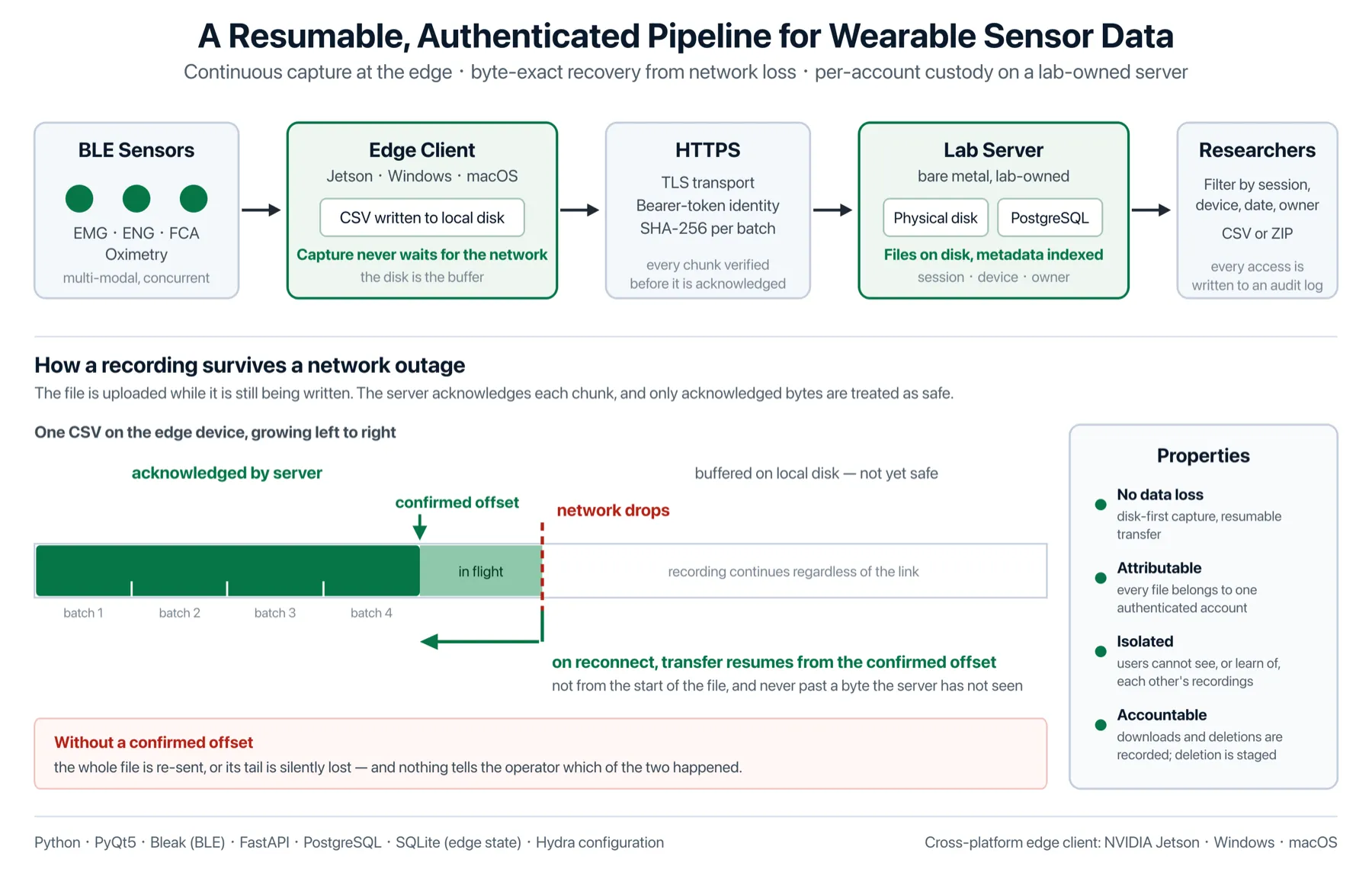
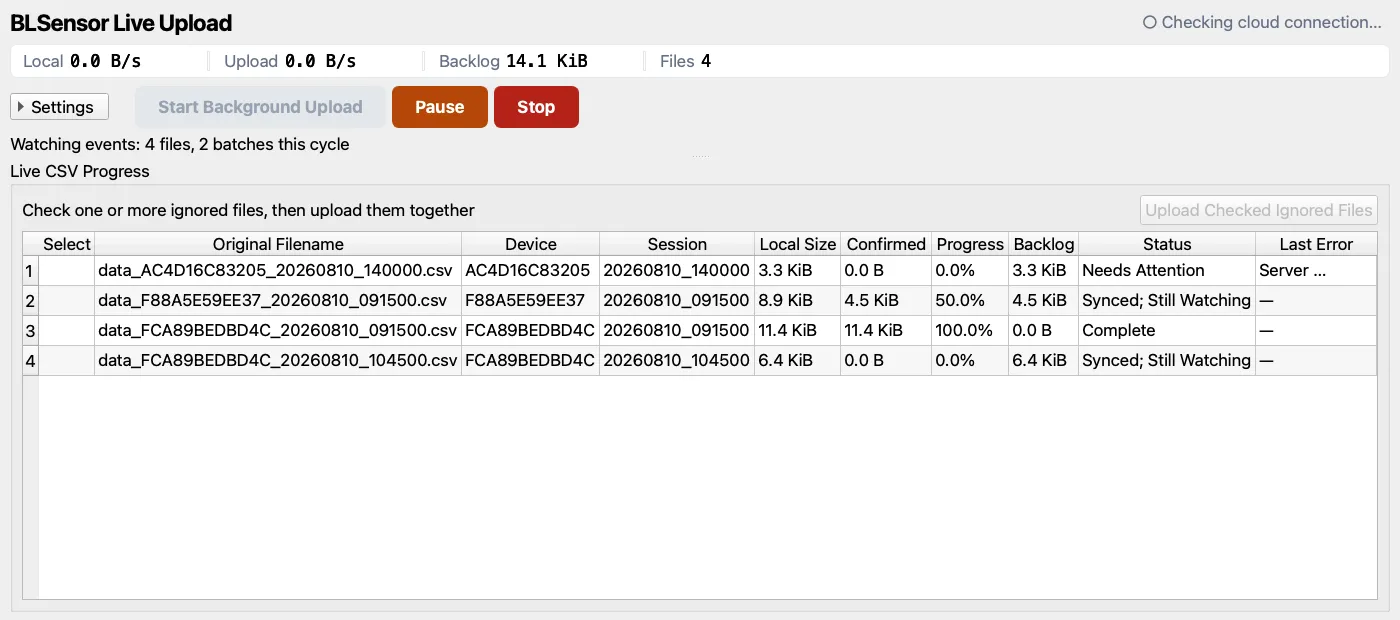
- Built a resumable incremental uploader: it sends data while recording is still going, and only the newline-terminated bytes the server has not yet acknowledged. Each file carries its own acknowledged byte offset, so a reconnect resumes from that byte instead of resending the file.
- A partial final row is never sent. It sounds like a detail, but without it the server receives half a record mid-session — and downstream analysis cannot tell a genuinely short row from an unfinished one.
- A retry sends the identical byte range and SHA-256. The server rejects gaps and treats an identical retry as a duplicate, which makes retrying safe by construction rather than by luck.
- Uploads are woken by native filesystem events (FSEvents on macOS, inotify on Linux/Jetson) rather than polling — polling is either slow or power-hungry, and an acquisition rig can afford neither.
- Completion is explicit: End Session and Quit writes a SHA-256 sidecar. Idle time is never treated as proof that acquisition has ended — to a filesystem, a subject taking a break and a finished experiment look identical.
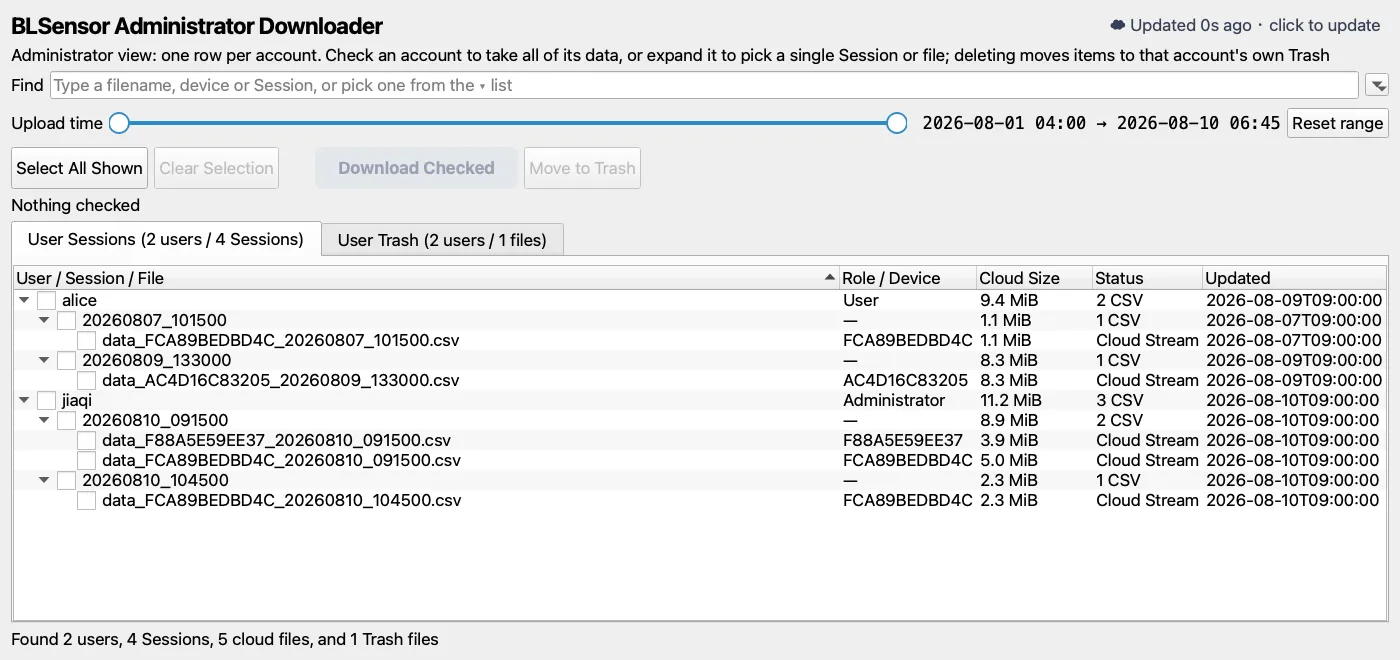
- Implemented accounts on the server with FastAPI and SQLAlchemy: data belongs to a person, and an administrator can retrieve it by user, by session, or by individual file. Deletion moves items to a trash with a retention countdown shown in the interface, rather than destroying them outright.
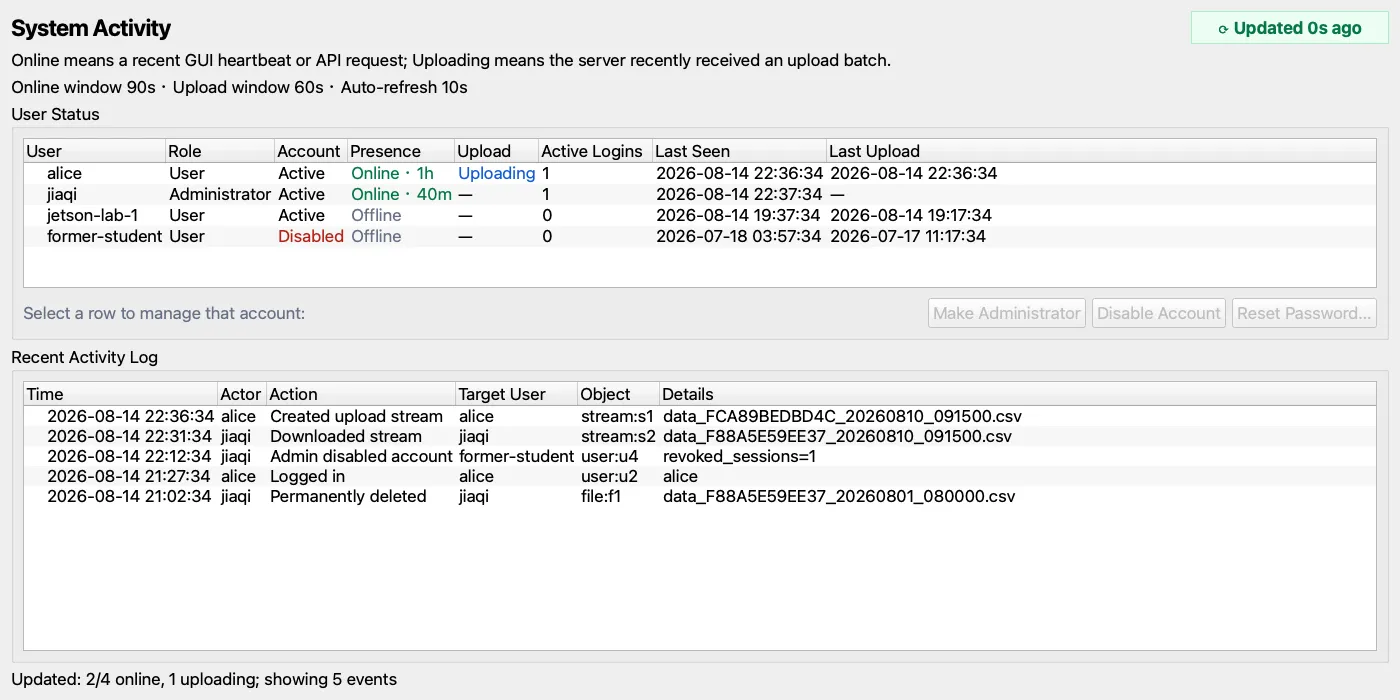
- Added an activity log covering sign-ins, sign-outs, permission changes and upload batches, so an administrator can see who is online and who has recently uploaded.
- Wrote a screenshot-by-screenshot manual for non-programmers. Not everyone who records data in the lab writes code — a system nobody can operate is no system at all.
The lab's existing BLE client only wrote data to the local disk. This work added everything downstream of that: getting the data to the server reliably while recording is still in progress, and giving it an owner once it arrives.
Technologies
- Python
- PyQt6
- FastAPI
- SQLAlchemy
- BLE / bleak
- Resumable upload
- SHA-256 verification
- FSEvents / inotify
- Hydra