SDR Text Transceiver
SDR Text Transceiver: M-PSK over USRP
Encode a passage of text, packetise it, modulate it, push it out of a USRP antenna — then pull it back out of the air and reconstruct the original.
- Role
- Course Project · Team of two
- Period
- Feb. 2026 – Jun. 2026
- Institution
- SUSTech
Why this matters
Modulation and demodulation in class run in simulation: no noise, no frequency offset, clocks perfectly aligned. Anything works. On real hardware the same algorithm has to survive sample-rate mismatch, carrier phase drift and packet boundaries it cannot find. The point of this project was never implementing PSK — it was getting PSK to work over a real link, where the receiver must first locate where a packet begins inside a continuous bit stream before demodulation means anything.
What I did
- The transmitter was written in class; our work was the receiver — swapping the queued input for real USRP drivers to close the hardware loop.
- Text is mapped to bits via Unicode, split into blocks, and wrapped with guard bits, a sync sequence, a packet number and a data field.
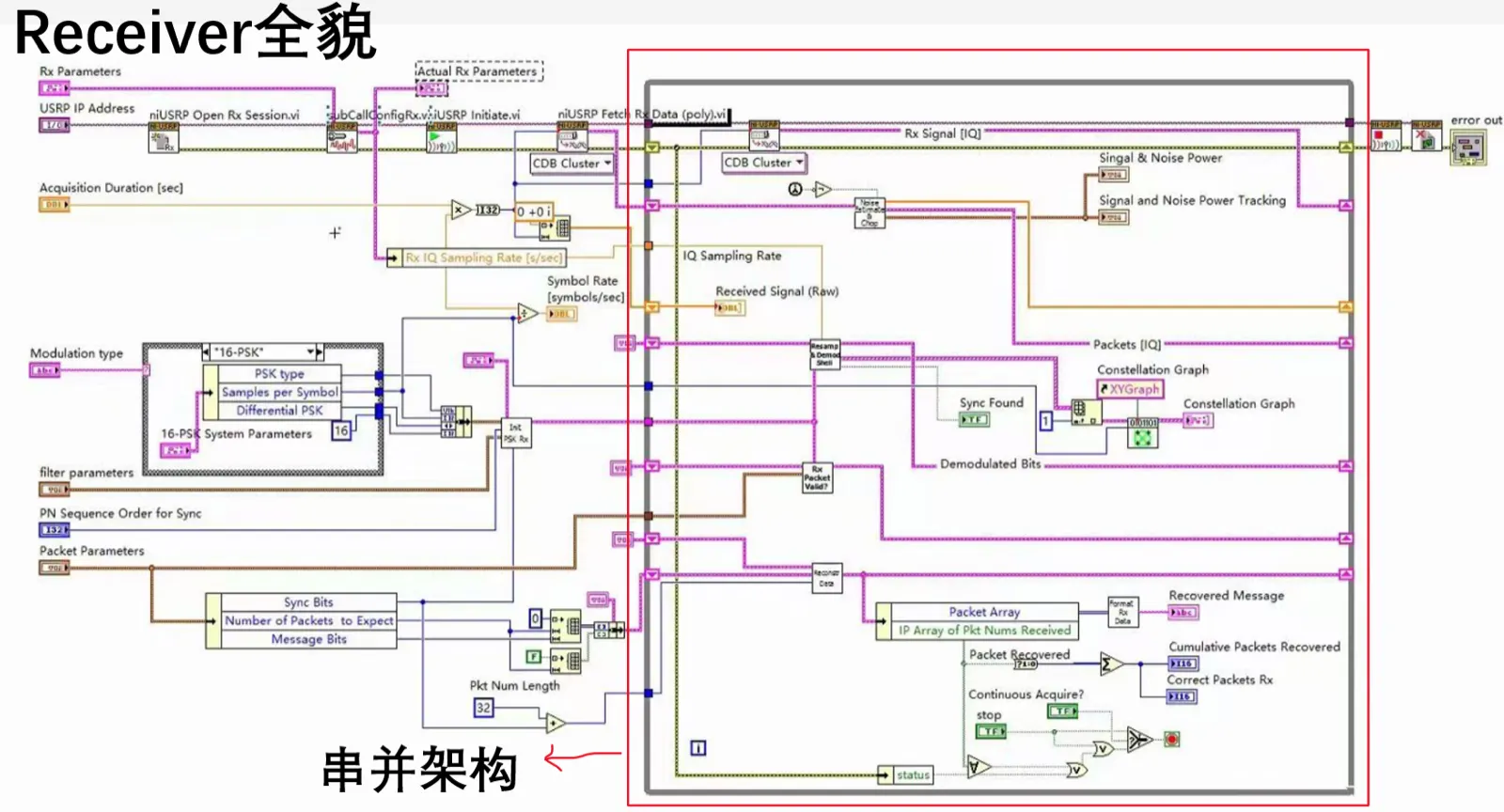
- Built the receive chain in LabVIEW: USRP session setup and configuration, IQ acquisition, resampling and PSK demodulation.
- Implemented frame synchronisation — searching the demodulated bit stream for the agreed sync sequence to locate packet starts, validating structure, then reassembling text by packet number.
- Used constellation and eye diagrams to judge signal quality in the phase and time domains respectively.
- Extended the modulation order from BPSK through QPSK and 8PSK to 16PSK, comparing demodulation behaviour at each.
A two-person course project. The transmitter was written in class; our work was the receiver — replacing the queued input with real USRP drivers so the text had to survive an actual wireless link.
Outcome
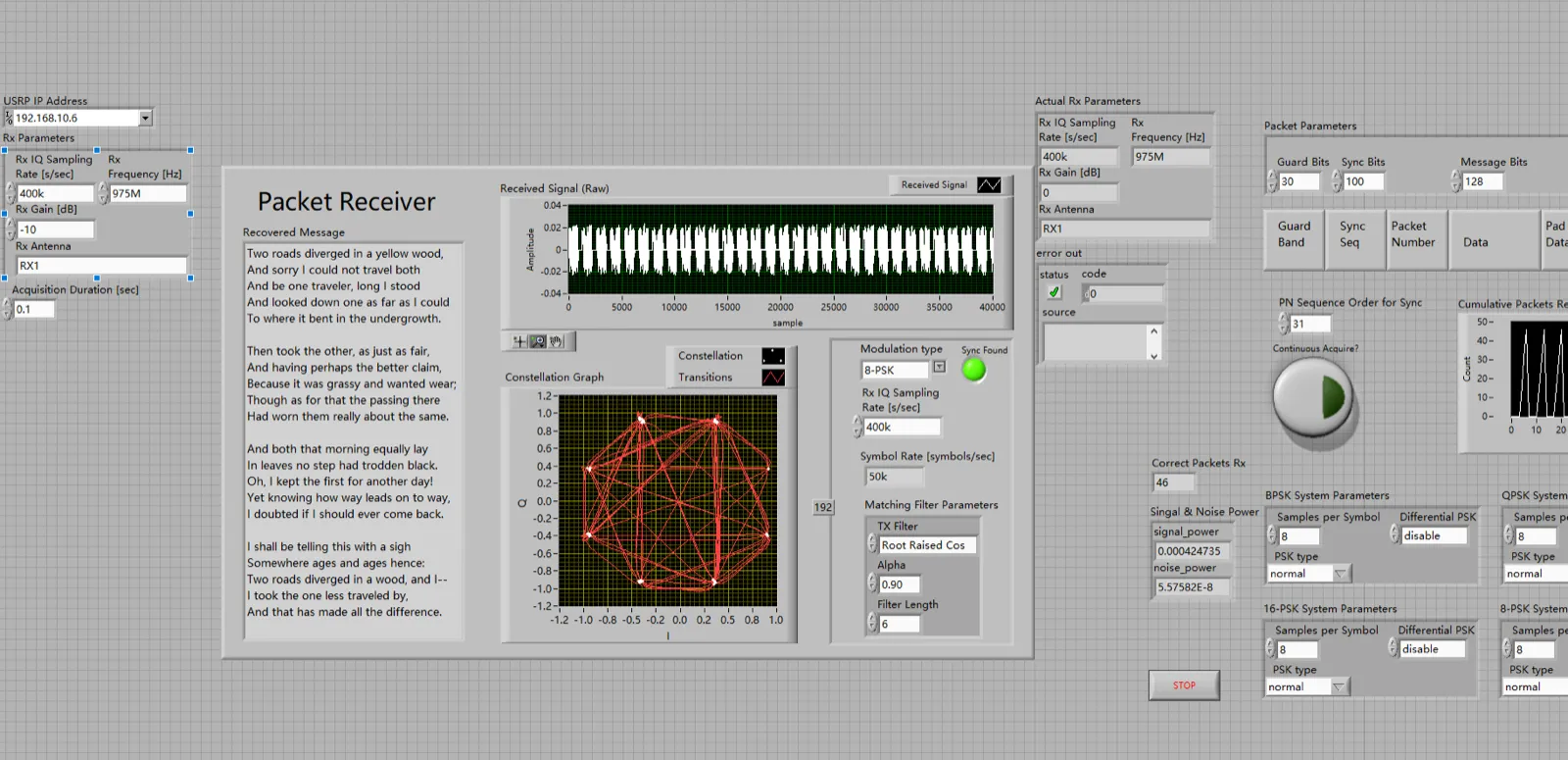
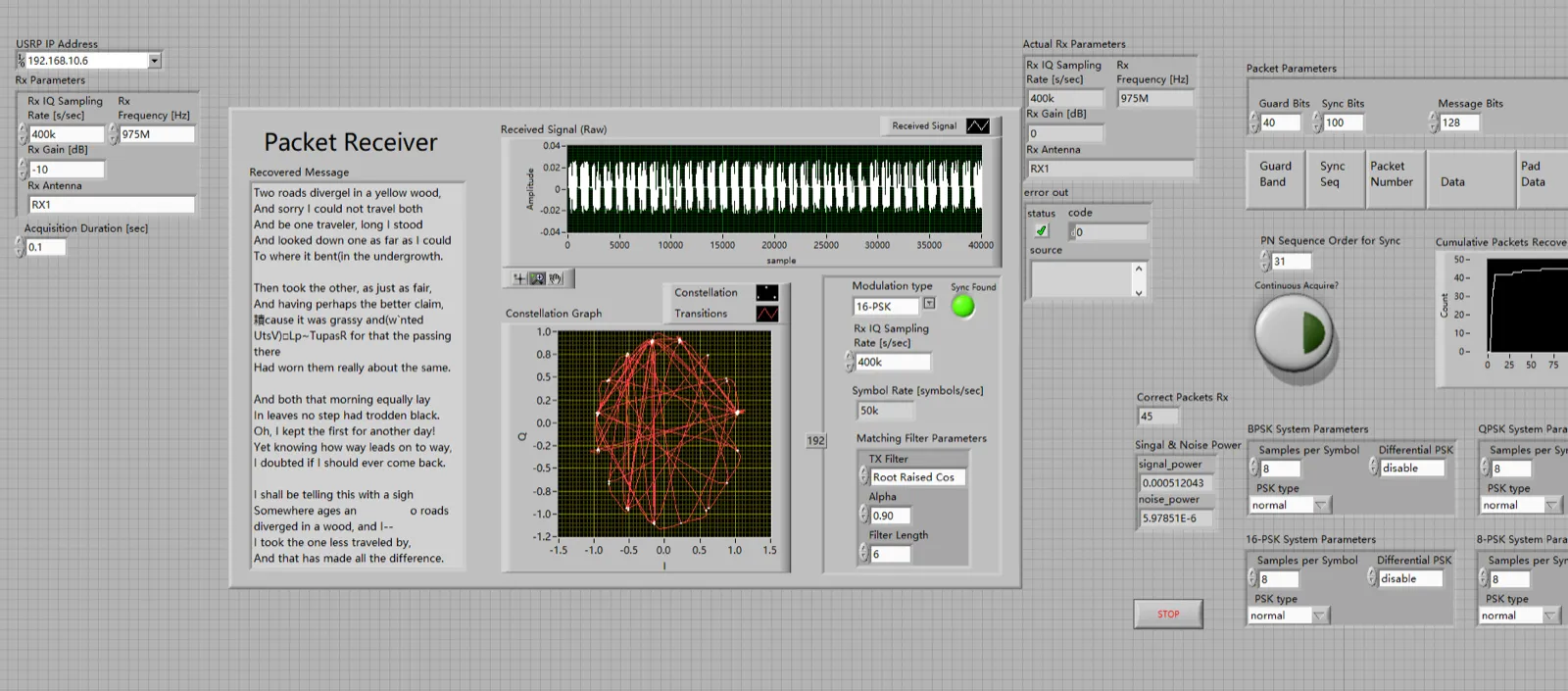
- At 8-PSK the text came back intact, with all 46 packets received correctly.
- At 16-PSK it garbled — phase spacing drops from 45° to 22.5°, and the same SNR stops being enough. Eight clean constellation points collapse into a smear; the failure explains the cost of higher-order modulation better than the formula does.
Technologies
- LabVIEW
- USRP
- Software-Defined Radio
- M-PSK Modulation
- Frame Synchronisation
- Constellation & Eye Diagrams